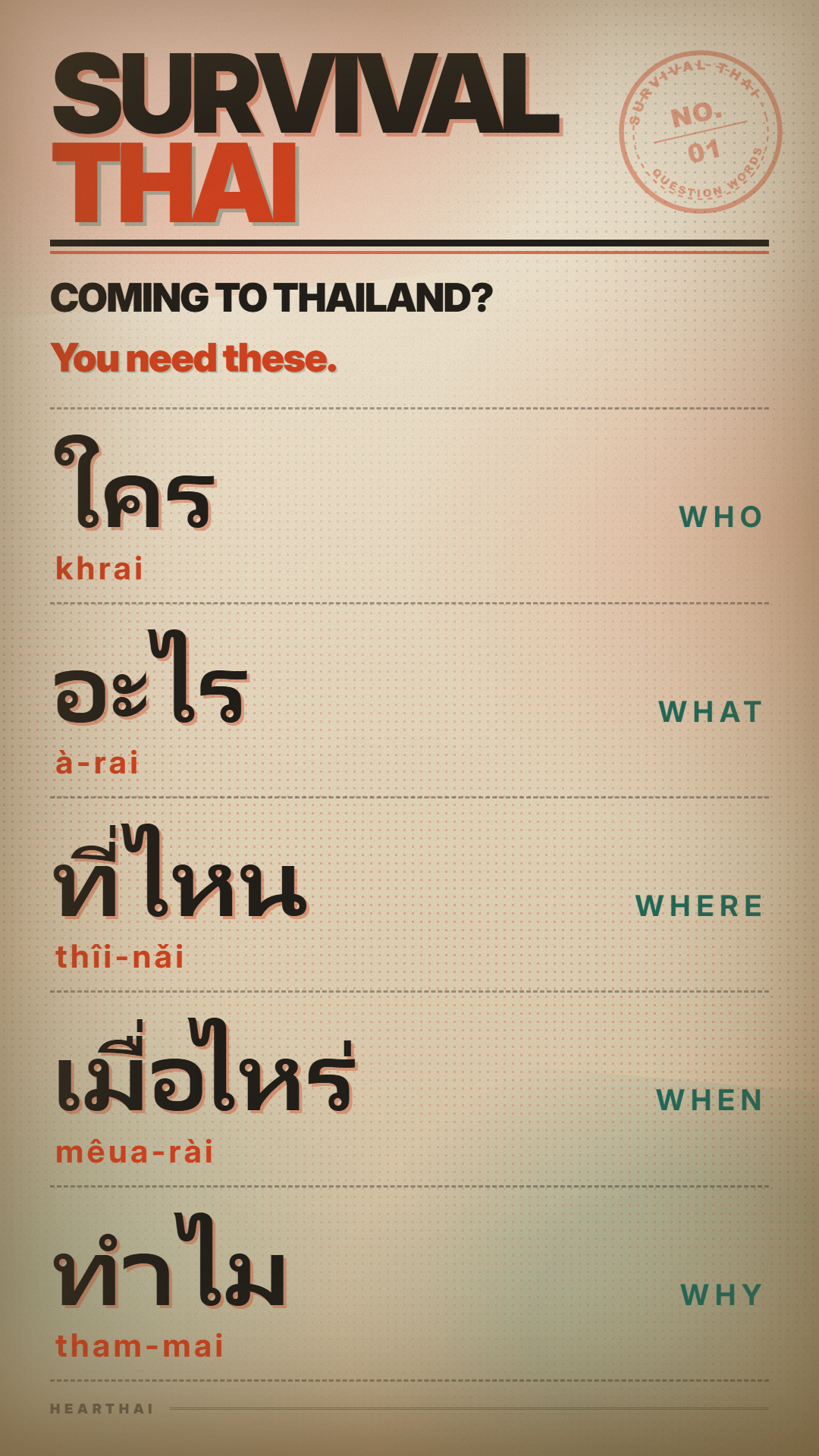
Survival Thai · No. 01 · QUESTION WORDS
How to Ask Questions in Thai: Who, What, Where, When, Why
Who is ใคร (khrai), what is อะไร (à-rai), where is ที่ไหน (thîi-nǎi). The five Thai question words, how to say them, and where they go in a sentence.
The words on this page
Tap any word to hear it. 5 of 5 have audio; tap the Thai to open its full pronunciation page.
Five words cover almost every question a traveler needs: ใคร khrai (who), อะไร à-rai (what), ที่ไหน thîi-nǎi (where), เมื่อไหร่ mêua-rài (when), ทำไม tham-mai (why).
You can say any one of them completely alone. Point at a dish and say à-rai and you have asked what it is. Hold up your ticket and say thîi-nǎi and someone will point you to the platform.
The one thing that matters: Thai question words mostly go at the end
This is the part that trips people up, because it is the reverse of English. In Thai, the question word usually sits where the answer would sit, and the answer almost always comes at the end of the sentence. So the shape is "you go where," not "where do you go." "The bus leaves when," not "when does the bus leave."
Two honest exceptions, so you're not surprised. khrai (who) comes first when who is the one doing the thing — "who came" lines up with English. And tham-mai (why) usually sits at the front too. The other three stay put at the end, which is where most of your questions will live.
You do not need to build those sentences yet. But you do need to recognize the shape, because when a Thai speaker asks you something, the word telling you what kind of question it is usually arrives last. If you switch off after the first two syllables, you miss it. Wait for the end.
Do I need to raise my voice at the end?
No, and it is worth unlearning early. English marks a question by lifting the pitch at the end. Thai marks it with a word instead, because pitch is already busy: it carries the identity of every syllable. Sweep your voice up at the end and you don't create a question, you garble the last word.
Thai sentences do have melody — it isn't a flat language. It just isn't the melody that makes something a question. The question word does that job by itself. Say thîi-nǎi with its own tones, correct and level, and you have asked.
Which two you will use most
à-rai and thîi-nǎi, by a distance. What is this, and where is that. Between those two and a pointed finger you can run a whole day.
tham-mai (why) is the one to go easy on. It is a perfectly normal word, but "why" questions from a stranger can land heavier in Thai than they do in English, especially aimed at someone who is working. Use it with people you know, or soften it by adding the polite particle for your gender.
Takeaways
- The five:
khraiwho,à-raiwhat,thîi-nǎiwhere,mêua-ràiwhen,tham-maiwhy. - Each works alone. One word plus a gesture is a complete, understood question.
- Thai usually puts the question word where the answer would go — at the end.
khraiandtham-maiare the two that can come first. - Don't raise your pitch to signal a question — the question word already does it.
- Add your polite ending after the question word, never before it.
These are 6 words.
HearThai Academy trains your ear on 25,000.
Premium audio for every word, the tone mechanics behind it, and games that make your ear do the work. Start free — no card.
Create a free accountFree trial. No card required.