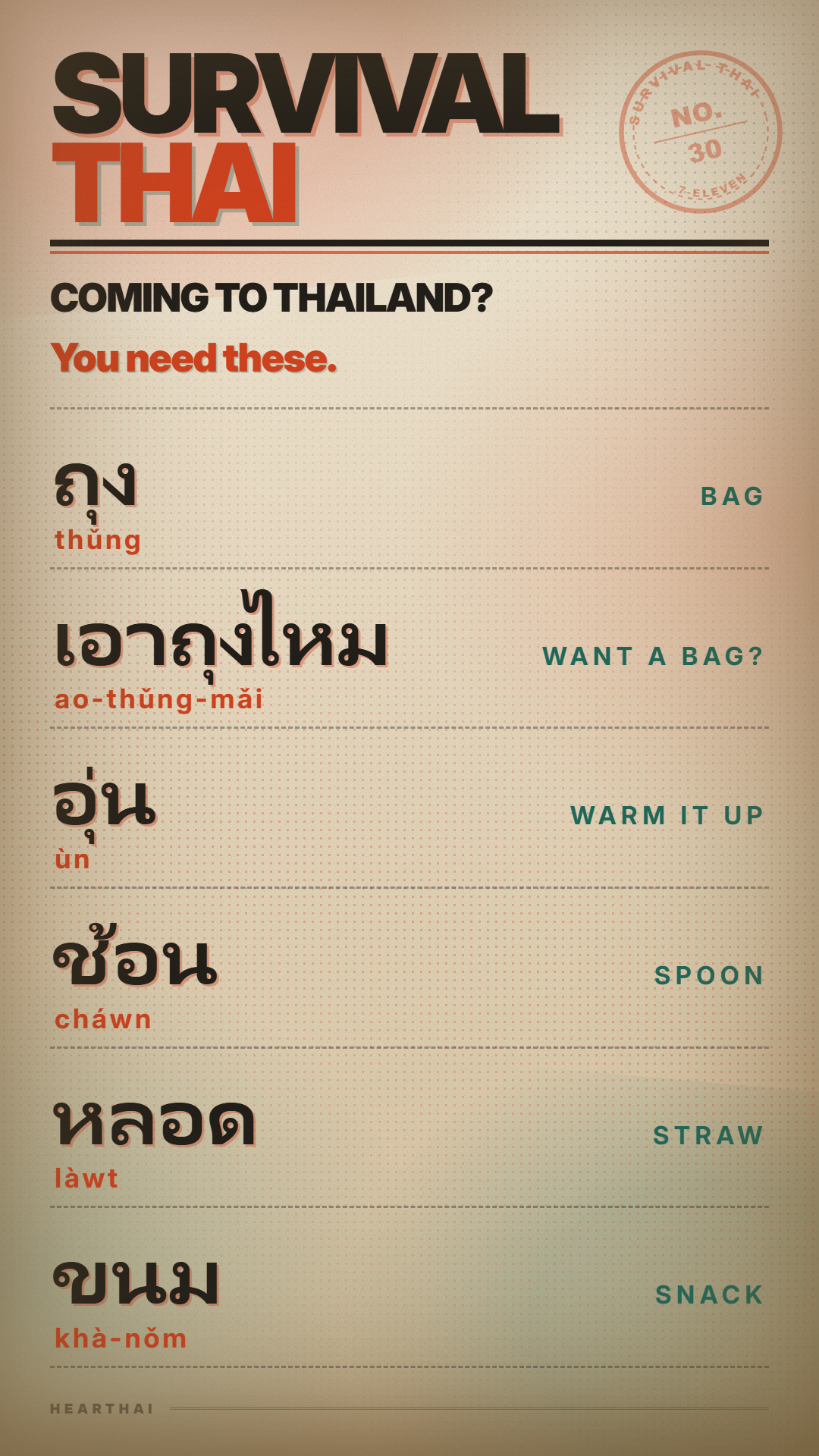
Survival Thai · No. 30 · 7-ELEVEN
What They Ask You at 7-Eleven in Thailand (in Thai)
เอาถุงไหม (ao-thǔng-mǎi) means 'want a bag?'. Warm it up is อุ่น (ùn). Six Thai words for the counter — mostly things you'll hear, not say.
The words on this page
Tap any word to hear it. 5 of 6 have audio; tap the Thai to open its full pronunciation page.
เอาถุงไหม ao-thǔng-mǎi — "want a bag?" That's the question fired at you at the counter, fast, every single time. ถุง thǔng is the bag.
Listen for the shape rather than the syllables. In real counter speed that last piece often comes out shorter and higher — closer to mái — and the whole thing lands as one blurred three-beat question. Once you've heard it a few times you'll catch it before you've parsed it.
The answer is ao if you do and mâi-ao if you don't, both from the bargaining page. This card closes the series the way it started: with a question you'll hear, not one you'll ask.
Why it's asked at all
Since 2020, Thailand's major retail chains have stopped handing out free single-use plastic bags automatically. It came out of a government-and-industry agreement rather than an outright ban, so bags haven't vanished — they just stopped being the default. The bag became a question instead, which is why you now get asked at speed while your change is being counted.
Carry a small folding bag and the question answers itself. If you do want one, ao and a nod is plenty.
ùn — the word that upgrades a 7-Eleven meal
อุ่น ùn means warm, and at a Thai convenience store it means "heat this up for me." Hand over the toasted sandwich, the rice dish or the pork bun and say ùn, and it goes in the microwave behind the counter.
This is not a marginal feature. Thai 7-Elevens sell genuinely decent hot food, the heated sandwiches have a following, and ùn is the one-syllable key to all of it. Also worth knowing: after they heat it, they will usually hand you a small bag of utensils without being asked.
cháwn and làwt
ช้อน cháwn is a spoon and หลอด làwt is a straw. Both are things you may need to ask for now that they're no longer given out by default, and both work as single words with khǎw on the front — "may I have."
Small cultural note that saves you fumbling: Thai food is generally eaten with a spoon in the dominant hand and a fork in the other, used to push food onto the spoon. Chopsticks are for noodle dishes. The spoon is the main instrument.
khà-nǒm — what's on those shelves
ขนม khà-nǒm covers snacks and sweets broadly: chips, cakes, candy, and traditional Thai sweets from a market stall. It's a wider word than "snack" in English and it's a good one to have when someone offers you something.
What else is a 7-Eleven for?
More than you'd think. Topping up your phone, paying bills, buying a SIM, buying sunscreen and repellent, breaking a 1000-baht note, getting cash back, and standing in the air conditioning for two minutes on a brutal afternoon. There is one on almost every corner, and it quietly solves a lot of the problems the rest of this series describes.
Takeaways
ao-thǔng-mǎi= "want a bag?" Answeraoormâi-ao.- Bags aren't automatic here — that's why you're always asked.
ùngets your food heated. It's the best one-word trick on this card.cháwnspoon,làwtstraw — ask withkhǎwin front.- The spoon is the main utensil in Thailand; the fork just loads it.
These are 6 words.
HearThai Academy trains your ear on 25,000.
Premium audio for every word, the tone mechanics behind it, and games that make your ear do the work. Start free — no card.
Create a free accountFree trial. No card required.